


Cultural centers are magical places. They share history, knowledge, and living culture with whoever walks through the door. Young people. Elders. Visitors who’ve never set foot on Tribal land before. Everyone who enters leaves knowing something they didn’t know before. So, the question worth sitting with is this: what is your cultural center saying?
And if you don’t have one yet, what do you want it to say?
A Cultural Center Belongs at the Center of Your Capital Plan
The same conversation comes up in budget planning meetings at Tribal Nations across the country. The gaming floor needs to be expanded. The hotel is aging. The parking structure can’t keep up with demand. All legitimate priorities. All real needs.
But somewhere in that list, the cultural center gets pushed to a future phase. The thing they’ll build when everything else is done.
I’d push back on that thinking. Gently, but sincerely.
A casino generates revenue. A cultural center generates identity. And identity, over generations, is what keeps a Nation’s story alive. Young people need a physical place to connect with who they are. Families need somewhere to gather around shared history. Economic success means something different when the community can see its culture honored alongside it.
The Association of Tribal Archives, Libraries, and Museums (ATALM) has developed a comprehensive framework based on this principle, acknowledging that identity and self-determination can be reflected in the architectural design of a cultural facility. The building itself becomes a statement of sovereignty. That framing has always resonated with me.
What We Learned from Shakopee
WORTHGROUP has had the privilege of working with the Shakopee Mdewakanton Sioux Community for many years. They’re a forward-thinking Nation. They invest in their community with real intention, and every project they build reflects that.
When we started working on their Cultural Center together, the goal wasn’t to design an impressive building. The goal was to create a space that grew out of the land and reflected the spirit of the SMSC community. Somewhere people could gather, celebrate, dance, drum, sing, craft, tell their story, learn, and just be together.
That meant starting differently. We didn’t come in with a concept already drawn. We came in with questions. The process was collaborative from the earliest stages through community approval, building consensus along the way. The result is a 85,000-square-foot structure that feels like it belongs exactly where it sits. Organic. Rooted. Delivered on time and on budget.
That project has since been cited publicly as an example of Tribal cultural architecture done right. The form, inspired by the shape of the tipi, has become a symbol recognizable well beyond Minnesota.
Then the Community Dreamed Even Bigger.
What started as a dream 20 years ago became Hoc̣okata Ti [ho-cho-kah-tah-tee], which means “the lodge at the center of their camp” in Dakota language.
WORTHGROUP served as design architect on this project, working alongside HTG Architects, the SMSC’s trusted community architect of nearly 30 years, who brought deep institutional knowledge and managed the construction documents process. That partnership mattered. A project like this doesn’t come together without both the vision and the trust that comes from decades of relationship on the ground.
The building that emerged from that collaboration is genuinely unlike anything I’ve seen. 85,000 square feet. Seven 40-foot tipi structures representing the Oceti Sakowiŋ, the Seven Council Fires of the Great Sioux Nation. A circular design throughout. Primary entry doors facing East, the traditional way one would enter a tipi. A skylight that tips to the West, with sunlight shining through colors representing the four cardinal directions. The circle as a recurring symbol, woven into room shapes, flooring, light fixtures, and furniture arrangements. There is only one right angle on the entire exterior perimeter wall. One.
Regional materials and earthen textures make the building appear to grow directly from its site. Not a single decision was arbitrary. Every detail carries meaning because the community put meaning into it.
The facility houses a 3,805-square-foot public exhibit called Mdewakanton: Dwellers of the Spirit Lake. The rest is reserved for community member use. Language teaching. History. Traditional arts. Artifact storage. Community gatherings. A living, breathing center for everything that makes this Nation who they are.
The Recognition That Followed
The recognition that followed says everything about what this building means beyond its walls.
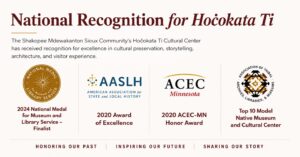
ATALM Top 10 Model Native Museum (2020)
The Association of Tribal Archives, Libraries, and Museums (ATALM) selected Hoc̣okata Ti as one of the Top 10 Model Native Museums and Cultural Centers in the country as part of their Culture Builds Communities initiative. The award was formally accepted in October 2022 at the ATALM conference in Temecula, California.
AASLH Award of Excellence (2020)
The public exhibit, Mdewakanton: Dwellers of the Spirit Lake, received the Award of Excellence from the American Association for State and Local History (AASLH), one of the most respected honors in the field of local history preservation.
ACEC-MN Honor Award (2020)
The American Council of Engineering Companies of Minnesota recognized Hoc̣okata Ti with an Honor Award for its striking, Dakota-inspired building design. An engineering and architectural achievement award that speaks directly to the quality of the design work.
2024 IMLS National Medal Finalist
Hoc̣okata Tṫi was named a finalist for the Institute of Museum and Library Services (IMLS) National Medal, the highest honor a museum or library can receive in the United States. It was the only institution in Minnesota and the only Native American organization selected as a national finalist that year.
Four national awards across design, history, cultural preservation, and community impact. When a community leads the process, the result speaks for itself.
What These Buildings Actually Do
Cultural centers get framed as sentimental sometimes. Nice to have. Meaningful, sure, but not strategic.
That framing undersells them completely.
These are spaces where language gets taught to children who might otherwise never hear it spoken. Where traditional arts get passed down in person, not through a screen. Where ceremonies have a permanent home. Where a young person from the community can walk in and see their own history honored and displayed with dignity, sometimes for the first time.
Beyond what they do internally, cultural centers signal something powerful outward too. A Nation that invests in its own story is a Nation that’s clear about who it is. That kind of sovereign expression carries real weight in how a community is seen, and in how it sees itself.
The Design Has to Come from the Community. Not the Architect.
A great cultural center can’t be designed in a studio and handed to a Tribe. That approach produces buildings that look right and feel hollow.
The process matters just as much as the product. Maybe more.
With the SMSC projects, our team spent real time listening. Not just to the CEO or the facilities director, but to elders, to youth, to community members who had opinions and stories and things they needed to see reflected in that space. That sustained listening is what makes the difference between a building that feels borrowed and one that feels true.
At WORTHGROUP, we call this designing with purpose. Not a tagline. The only way we know how to approach this work.
So, What Do You Want Yours to Say?
You don’t need a completed master plan to start this conversation. No fully approved budget required. No site already selected.
What you need is a willingness to ask the question. What do we want our children’s children to know about who we are? And what kind of place could hold that answer?
Every great cultural center starts there. With a question, not a blueprint.
If you’re at that stage, I’d love to talk. Not to sell you anything. Just to listen.
Sources & Further Reading
Hoc̣okata Ti ATALM Top 10 Recognition: shakopeedakota.org
2024 National Medal for Museum and Library Service Finalist: shakopeedakota.org
Hoc̣okata Ti Cultural Center Overview: shakopeedakota.org/culture/hocokatati
ATALM Indigenous Architecture & Design Considerations: atalm.org
SMSC Cultural Center Portfolio: worthgroup.com/portfolio/smsc-cultural-center